detection
(**) Focal Loss for Dense Object Detection, ICCV, 2017, code
Problem
- The highest accuracy object detectors to date are based on a two-stage approach popularized by R-CNN, where a classifier is applied to a sparse set of candidate object locations.
- In contrast, one-stage detectors that are applied over a regular, dense sampling of possible object locations have the potential to be faster and simpler, but have trailed the accuracy of two-stage detectors thus far.
- In this paper, we investigate why this is the case
- We discover that the extreme foreground-background class imbalance encountered during training of dense detectors is the central cause
Contribution
- In this paper, we propose a new loss function that acts as a more effective alternative to previous approaches for dealing with class imbalance.
Method
\[FL(p_t) = -\alpha_t(1 - p_t)^{\gamma}log(p_t)\]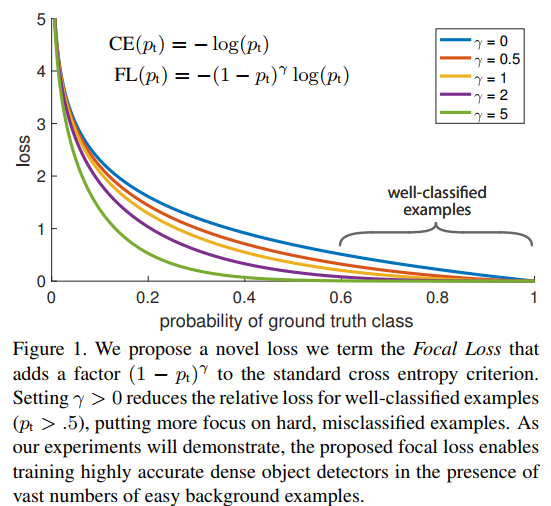
Result
Conclusion
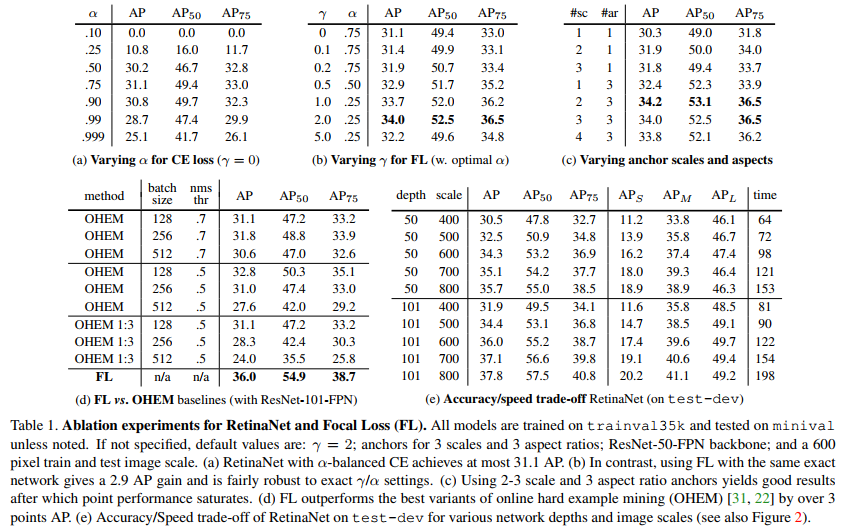
- we propose the focal loss which applies a modulating term to the cross entropy loss in order to focus learning on hard negative examples
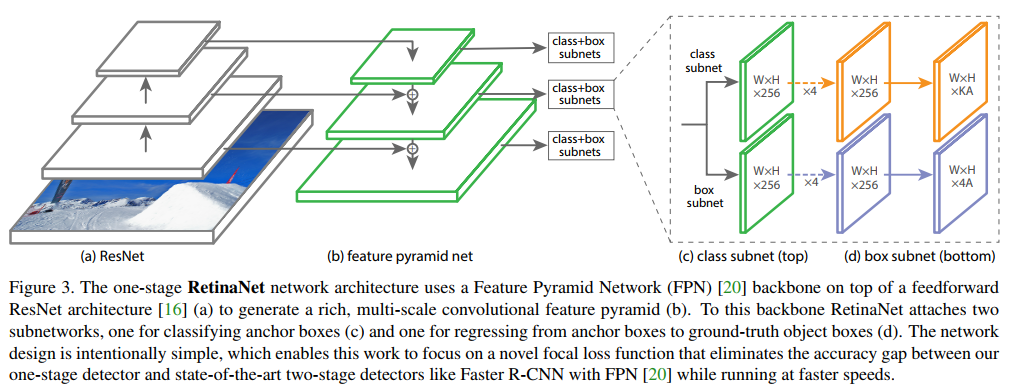
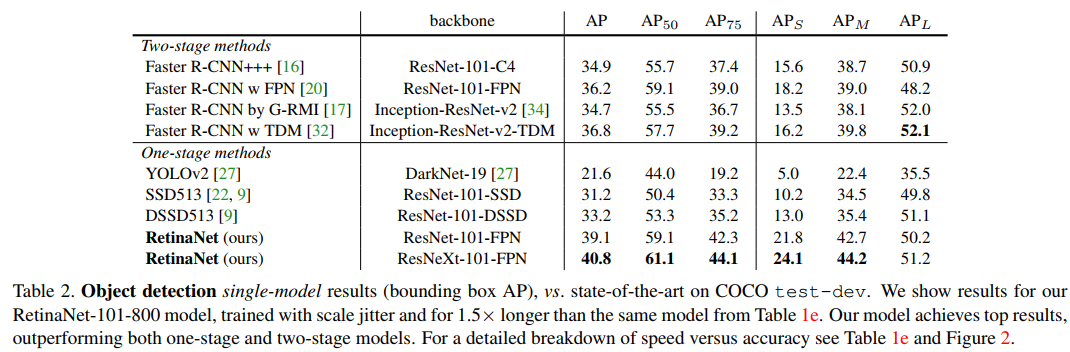
- We demonstrate its efficacy by designing a fully convolutional one-stage detector and report extensive experimental analysis showing that it achieves stateof-the-art accuracy and speed