-
- (***) Machine Learning Techniques for Biomedical Image Segmentation: An Overview of Technical Aspects and Introduction to State-of-Art Applications, Medical Physics, 2019, paper
- (***) Understanding Deep Learning Techniques for Image Segmentation, ACM Computing Surveys, 2019, paper
- (***) Deep Semantic Segmentation of Natural and Medical Images: A Review, arXiv, 2019, paper
Segmentation Review
(***) Machine Learning Techniques for Biomedical Image Segmentation: An Overview of Technical Aspects and Introduction to State-of-Art Applications, Medical Physics, 2019, paper
Comparision between Traditional Methods and Deep Learning based Methods
| Methods | Advantage | Disadvantage |
|---|---|---|
| Gredient based methods | Fast | Prone to image noise and artifacts that result in missing or diffuse organ boundaries. |
| Graph based methods (MRF et al.) | High computational cost due to iterative schedume. | |
| Superivsed methods + prior knowledge | capture shape well and generate more accurate results than unsupervised methods | Limitated results when dealing with fuzzy boundaries |
| Deep learning methods | Automatic feature extration scheme instead of manual feature extraction, More accurate | Large computational cost, and large amount of data |
Deep Learning based Methods
| Methods | Advantage | Disadvantage |
|---|---|---|
| Patch based CNN | Alleviate the coputational burden | 1. loss of spatial infortation 2. too small patchs means less information could be extracted 3. may increase training time due to the duplicated computation of pixels |
| Challenges | Current Solutions |
|---|---|
| Limited Training Data | 1. Data Augmentation 2. Transfer Learning 2. Generate data using GAN |
| Volumetric 3D Data cost training time and computer memory | 1. use 2D segmentation architectures instead of 3D architectures 2. use 2.5D architectures (an input data as several slice images, orthogonal images, maximum or minimum intensity projection) |
| Requires a lot of Hyperprameter Tuning | None |
(***) Understanding Deep Learning Techniques for Image Segmentation, ACM Computing Surveys, 2019, paper
Defination:
- Image segmentation can be defined as a specific image processing technique which is used to divide an image into two or more meaningful regions.
- Image segmentation can also be seen as a process of defining boundaries between separate semantic entities in an image.
- From a more technical perspective, image segmentation is a process of assigning a label to each pixel in the image such that pixels with the same label are connected with respect to some visual or semantic property
Categories
| Categories | Task | Notes |
|---|---|---|
| Semantic Segmentation | Each pixel is classified into one of the predefined set of classes such that pixels belonging to the same class belongs to an unique semantic entity in the image. | The semantics depends on the data and the problem that needs to be addressed |
| Saliency Detection | focusing on the most important object in a scene |
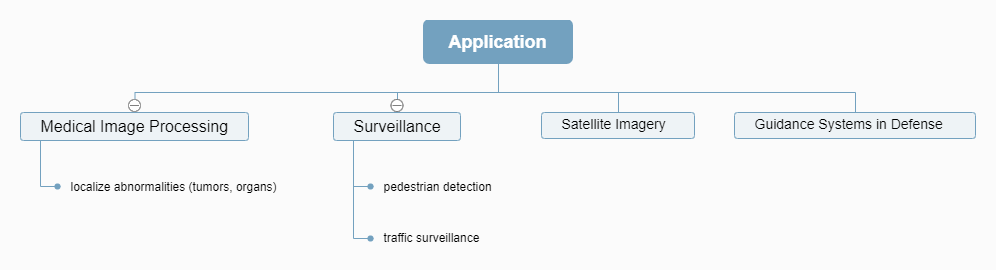
Application
Comparization
| Traditional Methods | Deep Learning Based Methods | |
|---|---|---|
| Advantage | 1. automated feature learning | |
| Disadvantage | 1. the results dependent on the quality of feature extracted by the domain experts 2. humans are bound to miss latent or abstract features for image segmentation |
(***) Deep Semantic Segmentation of Natural and Medical Images: A Review, arXiv, 2019, paper
Categories: 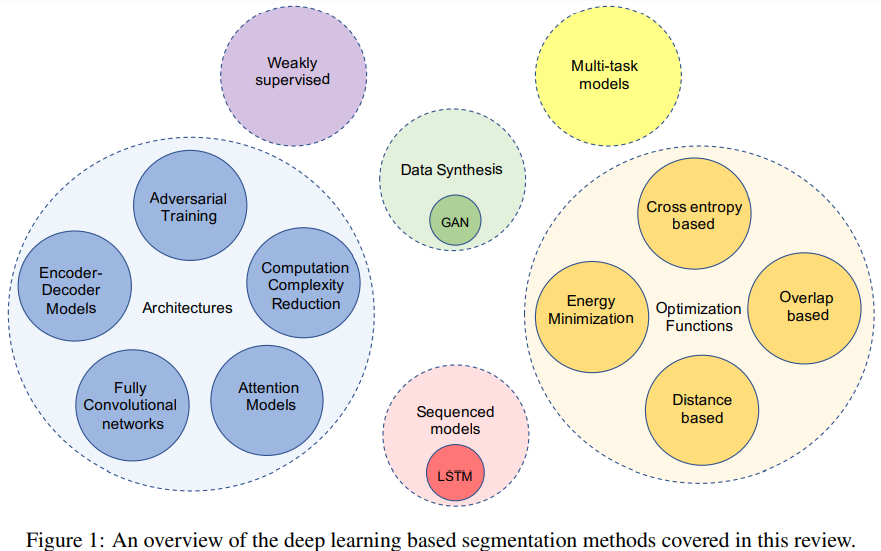
Potentional Difficulty
| difficulty | solutions | pros | cons |
|---|---|---|---|
| medical image can be in high dimentions (2D and 3D) | processed as sub-volumes (images) | reduce computing cost | prevent models capturing spatial information / relationships properly |
| lack of annotated data | 1. semi- or un-supervised learning 2. encoding prior knowledge into model |
Potential Future Directions
- Going beyond pixel intensity-based scene understanding via incorporating prior knowledge.
- Creating large 2D and 3D publicly available medical benchmark datasets for semantic image segmentation such as the Medical Segmentation Decathlon.
- Exploring reinforcement learning approaches for semantic (medical) image segmentation to mimic the way human does delineation.