-
Uncertainty Theory and Applications
- Theory
- Classification
- Segmentation
- Quality Prediction
- (***) Towards safe deep learning: accurately quantifying biomarker uncertainty in neural network predictions, MICCAI 2018, Paper
- (***) Leveraging Uncertainty Estimates for Predicting Segmentation Quality, arXiv 2018, Paper
- (***) Uncertainty-driven Sanity Check: Application to Postoperative Brain Tumor Cavity Segmentation, MIDL 2018, Paper
- Intervene Predictions
- (**) Exploring Uncertainty Measures in Deep Networks for Multiple Sclerosis Lesion Detection and Segmentation, MICCAI, 2018, Paper
- (**) MILD-Net: Minimal Information Loss Dilated Network for Gland Instance Segmentation in Colon Histology Images, Medical Image Analysis, 2019, Paper
- (**) Uncertainty-aware Self-ensembling Model for Semi-supervised 3D Left Atrium Segmentation, MICCAI 2019, code
- Quality Prediction
- Domain Adaption
Uncertainty Theory and Applications
Theory
(**) Dropout as a Bayesian Approximation: Representing Model Uncertainty in Deep Learning, ICML 2016, Paper
Problem
- Bayesian probability theory offers us mathematically grounded tools to reason about model uncertainty, but these usually come with a prohibitive computational cost
Contribution
- In this paper we give a complete theoretical treatment of the link between Gaussian processes and dropout, and develop the tools necessary to represent uncertainty in deep learning
- We show that the use of dropout (and its variants) in NNs can be interpreted as a Bayesian approximation of a well known probabilistic model: the Gaussian process (GP)
Result and Conclusion
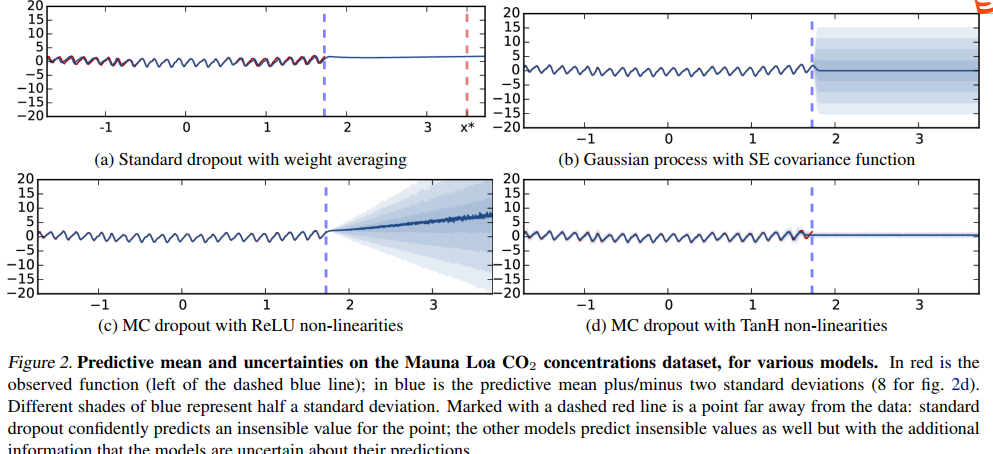
- We have built a probabilistic interpretation of dropout which allowed us to obtain model uncertainty out of existing deep learning models.
- We have studied the properties of this uncertainty in detail, and demonstrated possible applications, interleaving Bayesian models and deep learning models together.
(**) Assessing Reliability and Challenges of Uncertainty Estimations for Medical Image Segmentation, MICCAI 2019, Paper
Problem
- despite improvements in accuracy, the robustness aspects of these systems call for significant improvements for a successful clinical integration of these technologies, where each data point corresponds to an individual patient
- This highlights the importance of having mechanisms to effectively monitor computer results in order to detect and react on system's failures at the patient level
- This information in turn can be used to leverage the decision-making process of a user, as well as to enable time-effective corrections of computer results by for instance, focusing on areas of high uncertainty.
Different Levels of Uncertainty | Level | info | | ———————– | ——————————————————————————————————————————————————————————————————————————————————- | | Pixel (Volex) Level | 1. provides a measure of uncertainty for the predicted class of each voxel
2. providing additional information to foster comprehensibility or as guidance for correction tasks | | Instance (Object) Level | application: reduce the false discovery rate of brain lesions and cells | | Subject (Patient) Level | 1. informs us whether the segmentation task was successful (e.g., above a certain metric)
2. Having information about success or failure would be sufficient for many tasks, e.g., high-throughput analysis or selection of cases for expert review |
Contribuction
- Different approaches have been proposed to quantify uncertainties in deep learning models. including:
- Softmax Entropy
- MC dropout
- Aleatoric uncertainty
- Ensembles
- Auxiliary network
- we evaluated common uncertainty measures with respect to their reliability, their benefit, and limitations.
- we analyzed the requirements for uncertainties in medical image segmentation and we make practical recommendations for their evaluation.
Result and Conclusion 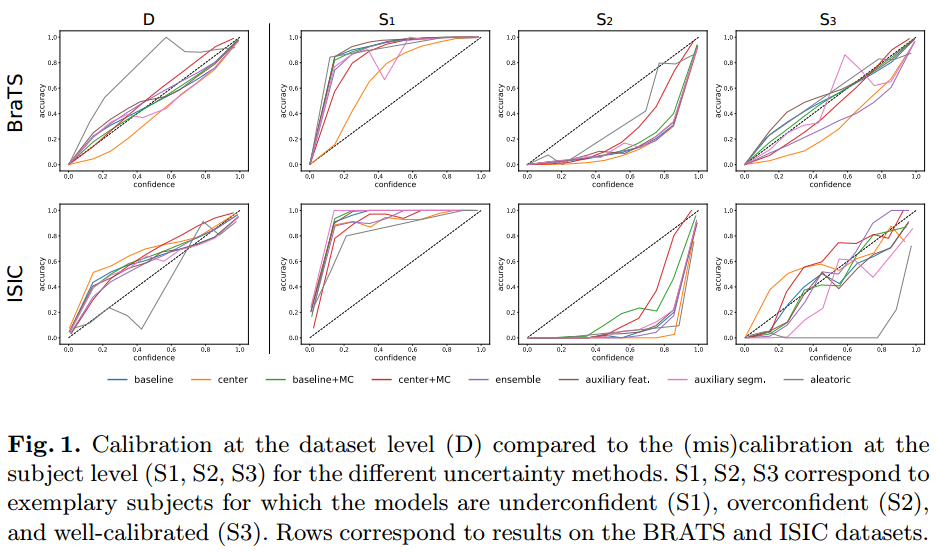
- (Important) Results show that current uncertainty methods perform similarly and although they are well-calibrated at the dataset level, they tend to be miscalibrated at subject-level
- The results also revealed that methods based on MC dropout are heavily dependent on the influence of dropout on the segmentation performance
- From our experiments we can conclude that methods that aggregate voxel-wise uncertainty to provide subject-level estimations are not reliable enough to be used as a mechanism to detect failed segmentations.
- The aleatoric method fails to produce uncertainty at the locations of segmentation errors (i.e., low U-E) and is therefore unable to improve segmentation results through corrections
Limitation
- First, although the experiments were performed on two typical and distinctive datasets, they feature large structures to segment. The findings reported herein may differ for other datasets, especially if these consists of very small structures to be segmented
- Second, the assessment of the uncertainty is influenced by the segmentation performance. Even though we succeeded in building similarly performing models, their differences cannot be fully decoupled and neglected when analyzing the uncertainty
Classification
Segmentation
Quality Prediction
(***) Towards safe deep learning: accurately quantifying biomarker uncertainty in neural network predictions, MICCAI 2018, Paper
Problem
- Automated medical image segmentation, specifically using deep learning, has shown outstanding performance in semantic segmentation tasks.
- However, these methods rarely quantify their uncertainty, which may lead to errors in downstream analysis.
Contribution
- In this work we propose to use Bayesian neural networks to quantify uncertainty within the domain of semantic segmentation.
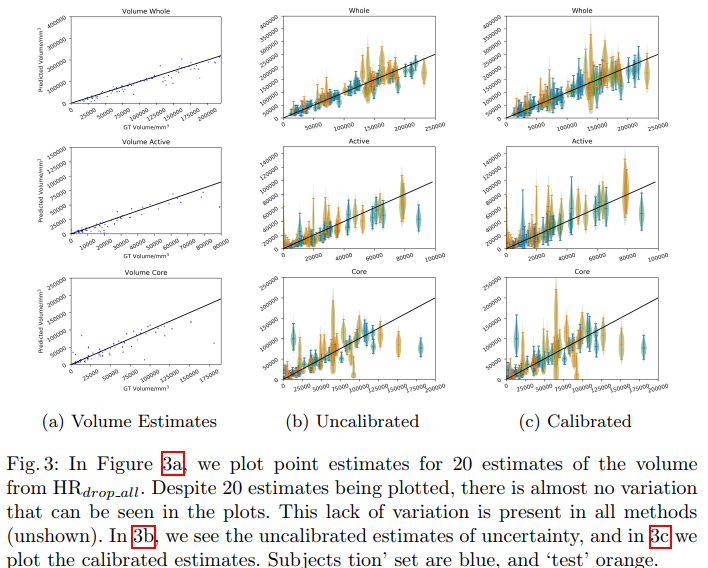
- We also propose a method to convert voxel-wise segmentation uncertainty into volumetric uncertainty, and calibrate the accuracy and reliability of confidence intervals of derived measurements.
Result and Discusion
- Empirically, we have found that the model with dropout in every layer produced the most stable variance estimates, whilst being computationally simple to implement.
- As noise increases, we see the segmentation error increase: also, we see the estimated volume reducing with added noise.
- In conclusion, we have shown how to produce calibrated confidence intervals for volumetric analysis, with a non-disruptive extension to a typical deeplearning pipeline
(***) Leveraging Uncertainty Estimates for Predicting Segmentation Quality, arXiv 2018, Paper
Problem
- despite the recent successes reported in the literature, we have yet to see the widespread adoption of deep learning in clinical settings
- One possible reason for this delay could be the lack of suitable uncertainty estimates
Contribution
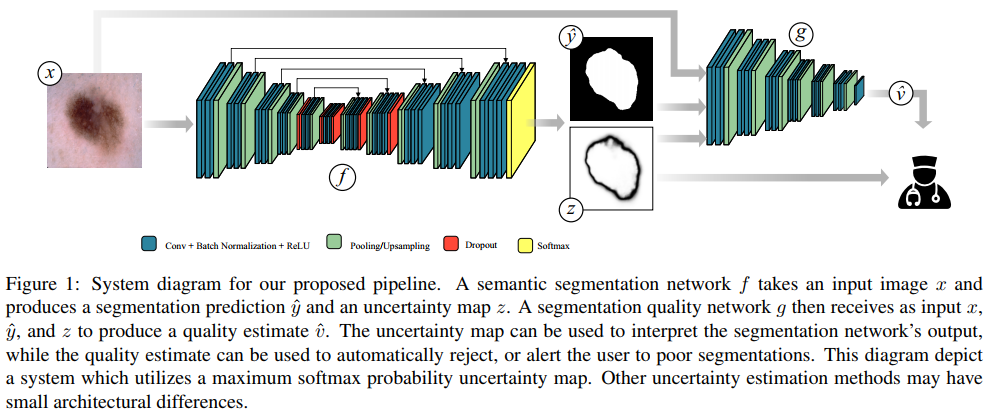
- We propose learning spatial uncertainty maps for each segmentation, which can then be used to improve our prediction of the quality of the segmentation
Method
Results and Discusion
- Require futher reading ….
(***) Uncertainty-driven Sanity Check: Application to Postoperative Brain Tumor Cavity Segmentation, MIDL 2018, Paper
Background and Problem
- Uncertainty estimates of modern neuronal networks provide additional information next to the computed predictions and are thus expected to improve the understanding of the underlying model
- Reliable uncertainties are particularly interesting for safety-critical computer-assisted applications in medicine, e.g., neurosurgical interventions and radiotherapy planning
Contribution
- We propose an uncertainty-driven sanity check for the identification of segmentation results that need particular expert review
Mehthod
- we extract the essential information contained in the uncertainty maps, and summarize into a doubt score. The doubt score $dbt$ for one predicted image is defined as:
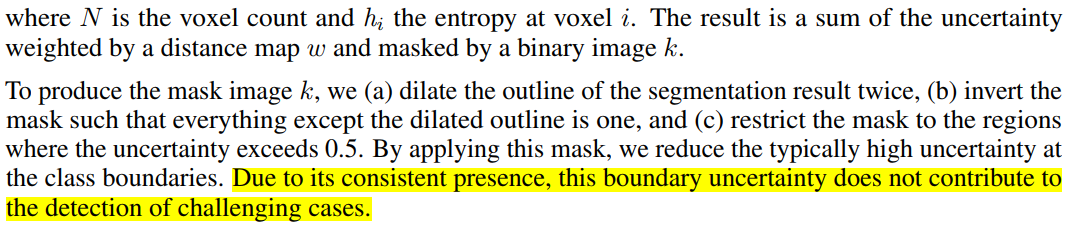
Result and Discussion
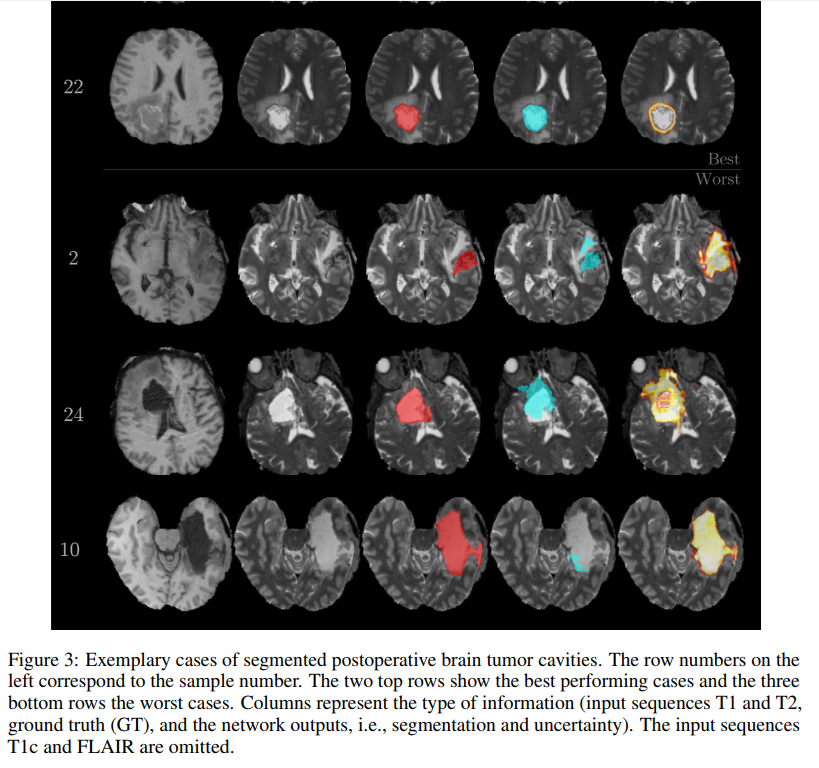
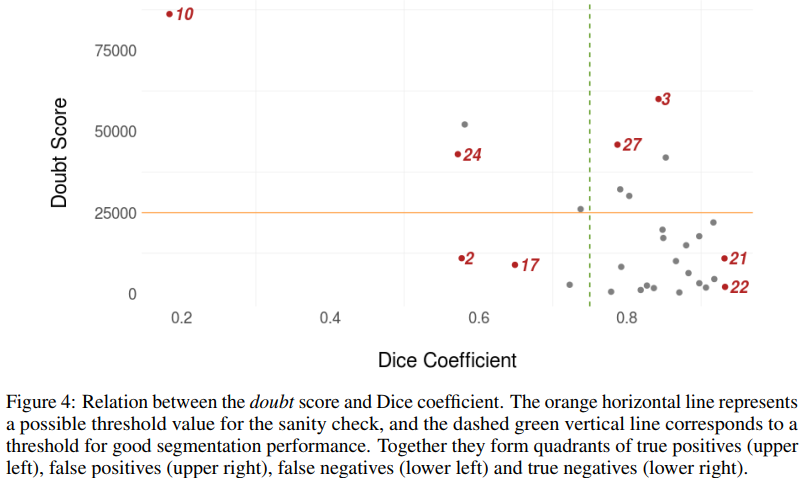
- Typically, one would expect a rather low doubt scores for good segmentation results, which would allow a simple detection of the failing segmentation cases.
- But the results revealed cases with high Dice coefficient and high doubt scores.
- Even though such cases were classified as false positives in terms of failure detection, their claim for review is justified
Intervene Predictions
(**) Exploring Uncertainty Measures in Deep Networks for Multiple Sclerosis Lesion Detection and Segmentation, MICCAI, 2018, Paper
Background
- (Research Status 1) DL methods typically produce predictors with deterministic outcomes. In contrast, traditional Bayesian machine learning provides not only a prediction, but also an uncertainty about it, through a probability density over outcomes.
-
(Research Status 2) While mathematically principled, traditional Bayesian approaches to DL have not been widely used in applications due to implementation challenges and excessive training times. Recently, Gal and Ghahramani [4] presented a simpler approach to uncertainty estimation for DL, by training a dropout network and taking Monte Carlo (MC) samples of the prediction using dropout at test time. This approach produces an approximation of the posterior of the network's weights.
- (Application Prospect) uncertainty measures in the results of an automatic, DL detection or segmentation method provide clinicians or radiologists with information, mation permitting them to quickly assess whether to accept or reject lesions of high uncertainty, for example, or further analyze uncertain lesion boundaries. This could facilitate the wider adoption of DL methods into clinical work-flows.
Problem
- DL methods typically produce predictors with deterministic outcomes. In contrast, traditional Bayesian machine learning provides not only a prediction, but also an uncertainty about it, through a probability density over outcomes.
- Uncertainty estimates for the predictions would permit subsequent revision by clinicians.
Contribution
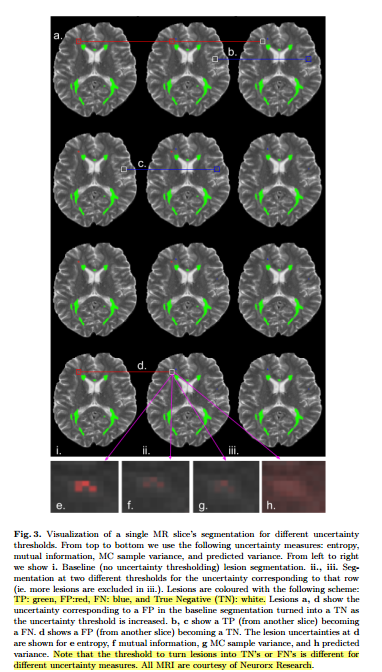
- We present the first qualitative and quantitative comparison of the effectiveness of several different uncertainty measures derived from MC dropout in the context of DL for lesion segmentation and detection in medical images
- We develop a 3D MS lesion segmentation CNN, augmented to provide four voxel-based uncertainty measures based on MC dropout: predictive variance, MC sample variance, predictive entropy, and mutual information.
- Voxel-wise uncertainties are combined to estimate lesion-level uncertainties.
- Our results indicate that while bigger lesions have large voxel-based uncertainties primarily along the border, the smallest lesions have the highest lesion-level detection errors, along with the highest uncertainty.
Method
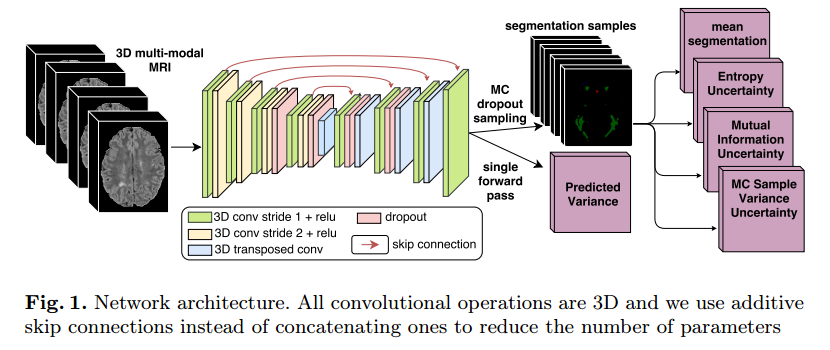
- The standard approach to generate a classification would be to compute the indicator function $1_{y_i \ge \theta}$ where the threshold $\theta$ is specified (eg. 0.9). When we use the uncertainty measure, we will additionally require that $U_m(i)$ is below another chosen threshold $\eta$ in order to produce the prediction.
- Suppose we can generate a large set of candidate lesions. For a candidate $l$, composed of voxels $p…q$, we will compute the lesionuncertainty $U_m(l)$ from the voxel-wise uncertainties as: $U_m(l) = \sum_{i=p}^{q}log(U_m(i))$.
- we rescale the values $U_m(l)$ to $[0, 1]$, Detection is then performed using the uncertainty threshold and outputs in the same case as for the voxel-level.
Results and Conclusion
- In general, measures computed from stochastic dropout samples are more uncertain around lesion contours.
- Despite these voxel-wise differences, when accumulating evidence to the lesion-level, the different measures tend to rank lesions is the same order of certainty, albeit on different scales, which leads to filtering out the same lesions, at different thresholds
- We also note that small lesions are relatively more uncertain than medium and large lesions. This is a consequence of computing lesion uncertainty from the log sum of all the uncertainty values in a detected lesion area
- Although large lesions have larger, more uncertain contours, the accumulation of lesion-evidence within the boundary provides an overwhelming certainty that there is a lesion there. This is not the case for small lesions (less evidence).
- Our results indicate that filtering based on uncertainty greatly improves lesion detection accuracy for small lesions, which make up 40% of the dataset, indicating that high uncertainty does indeed reflect incorrect predictions
(**) MILD-Net: Minimal Information Loss Dilated Network for Gland Instance Segmentation in Colon Histology Images, Medical Image Analysis, 2019, Paper
Problem and Challenge
- First, a high-resolution level is needed for precise delineation of glandular boundaries, that is important when extracting morphological measurements
- Next, glands vary in their size and shape, especially as the grade of cancer increases
-
Furthermore, the output of solely the gland object gives limited information when making a diagnosis. Extra information, such as the uncertainty of a prediction and the simultaneous segmentation of additional histological components, may give additional diagnostic power.
- (About Uncertainty) This paper made a detailed review on deep learning based uncertainty In Section 2.3.
Contribution
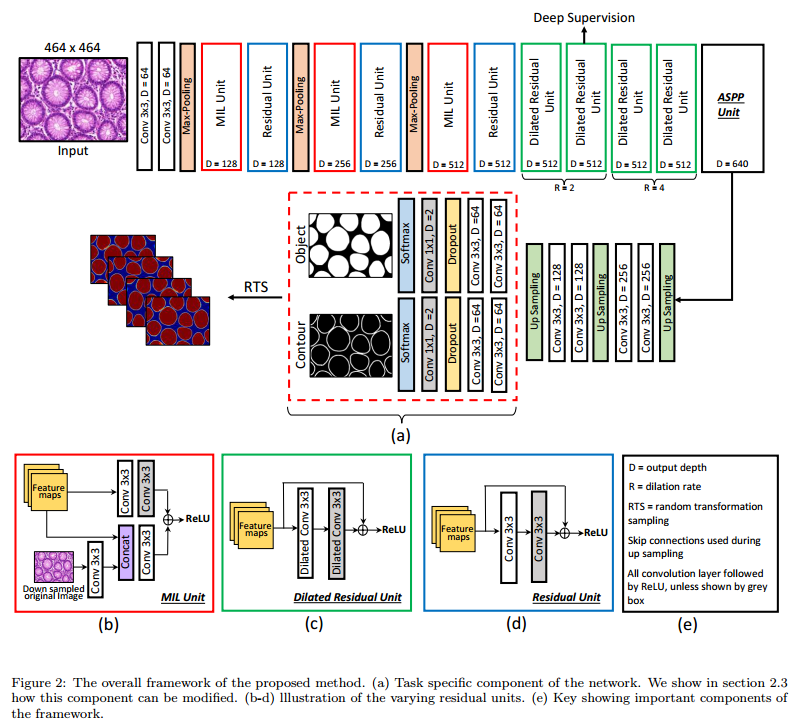
- we propose a minimal information loss dilated network that aims to solve the key challenges posed by automated gland segmentation.
- During uncertainty quantification, we apply random transformations to the input images as a method of generating the predictive distribution
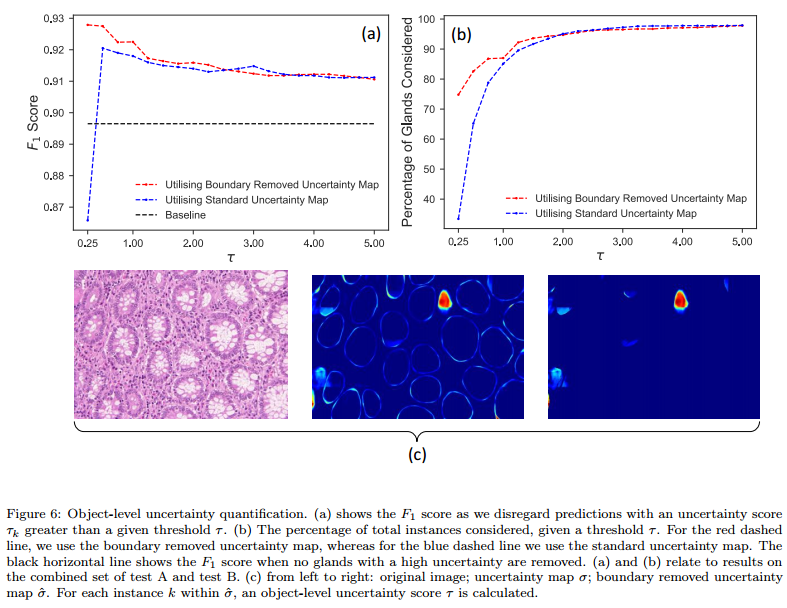
- Furthermore, we use this measure of uncertainty to rank images that should be prioritized for pathologist annotation.
- We propose a metric to give individual glands a score of uncertainty, based on the uncertainty map generated via random transformation sampling
Method
Results and Discusion
- We have shown that this uncertainty map can be used as additional information about where the algorithm is uncertain.
- Also, we have shown that if we choose not to extract features from predictions with high uncertainty, we can signifcantly increase the performance whilst maintaining a large proportion of the dataset.
- This workflow mimics clinical practice because the pathologist would not make a diagnosis from areas of ambiguity
(**) Uncertainty-aware Self-ensembling Model for Semi-supervised 3D Left Atrium Segmentation, MICCAI 2019, code
Problem
- In the medical imaging domain, however, it is expensive and tedious to delineate reliable annotations from 3D medical images in a slice-by-slice manner by experienced experts
- Since unlabeled data is generally abundant, we focus on studying semi-supervised approach on LA segmentation by leveraging both limited labeled data and abundant unlabeled data.
Contribuction
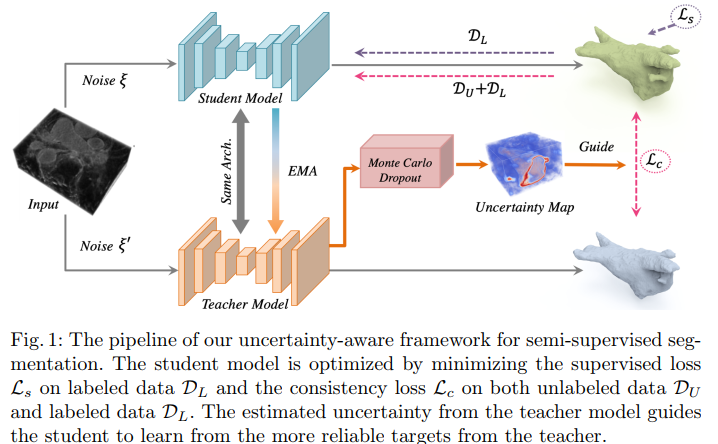
- we present a novel uncertainty-aware semi-supervised learning framework for left atrium segmentation from 3D MR images by additionally leveraging the unlabeled data
- we design the uncertaintyaware mean teacher (UA-MT) framework, where the student model gradually learns from the meaningful and reliable targets by exploiting the uncertainty information of the teacher model
Method
Result and Conclusion
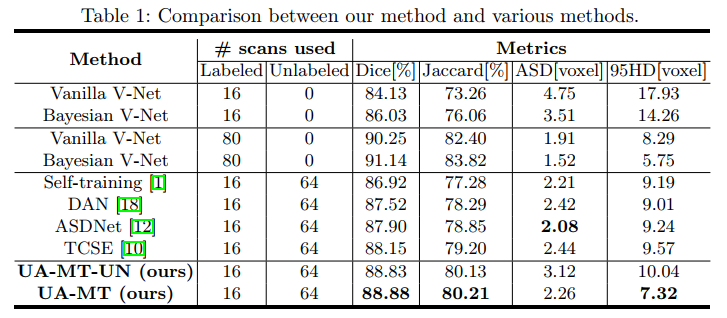
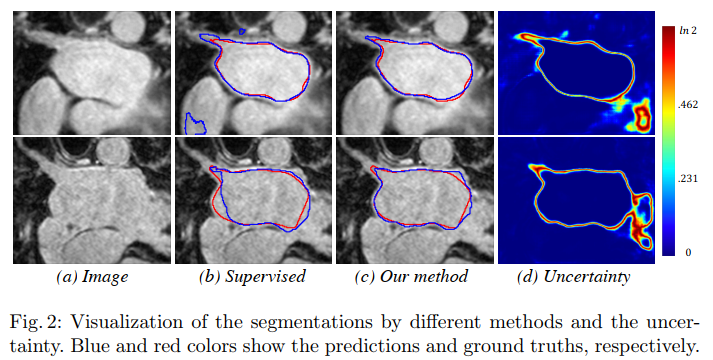
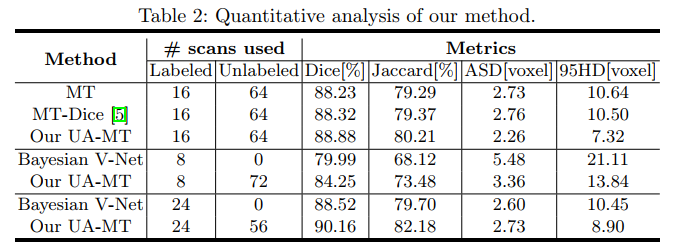
- Our method encourages the segmentation to be consistent for the same input under different perturbations to use the unlabeled data
- More importantly, we explore the model uncertainty to improve the quality of the target
- The comparison with other semi-supervised methods confirm the effectiveness of our method