Classification
(**) Densely Connected Convolutional Networks, CVPR, 2017, paper
Problem
- As CNNs become increasingly deep, a new research problem emerges: as information about the input or gradient passes through many layers, it can vanish and "wash out" by the time it reaches the end (or beginning) of the network.
Contribuction
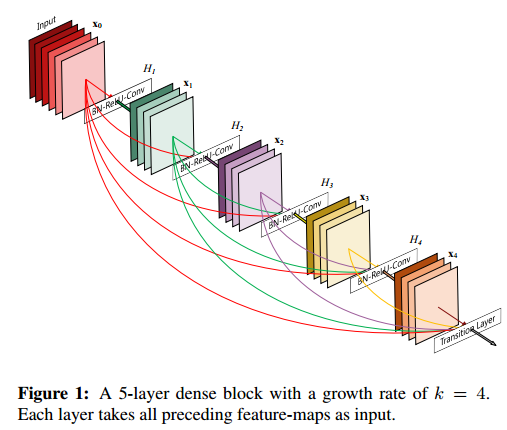
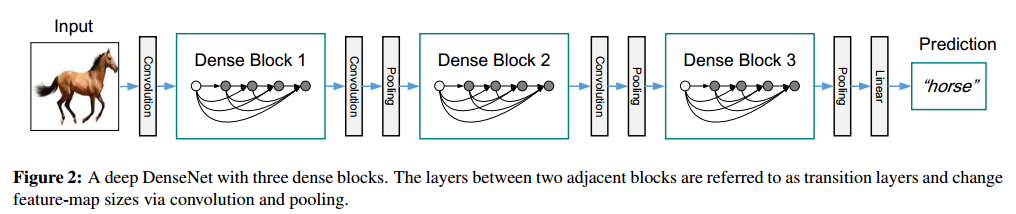
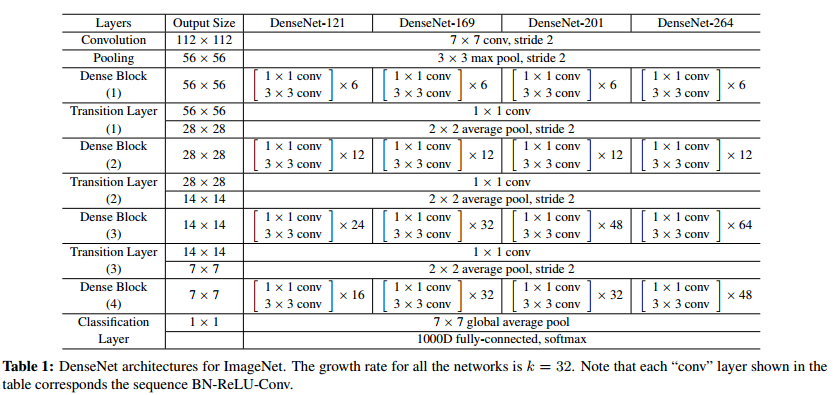
- we propose an architecture that distills this insight into a simple connectivity pattern: to ensure maximum information flow between layers in the network, we connect all layers (with matching feature-map sizes) directly with each other.
- A possibly counter-intuitive effect of this dense connectivity pattern is that it requires fewer parameters than traditional convolutional networks, as there is no need to relearn redundant feature-maps.
- Besides better parameter efficiency, one big advantage of DenseNets is their improved flow of information and gradients throughout the network, which makes them easy to train.
- Further, we also observe that dense connections have a regularizing effect, which reduces overfitting on tasks with smaller training set sizes.
- DenseNets perform a similar deep supervision in an implicit fashion: a single classifier on top of the network provides direct supervision to all layers through at most two or three transition layers.
Method
Result and Conclusion
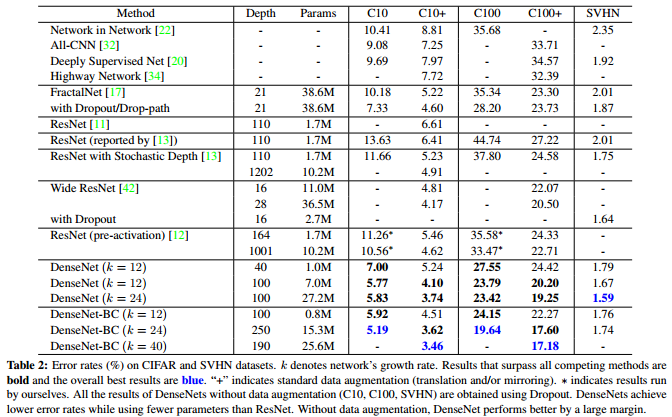
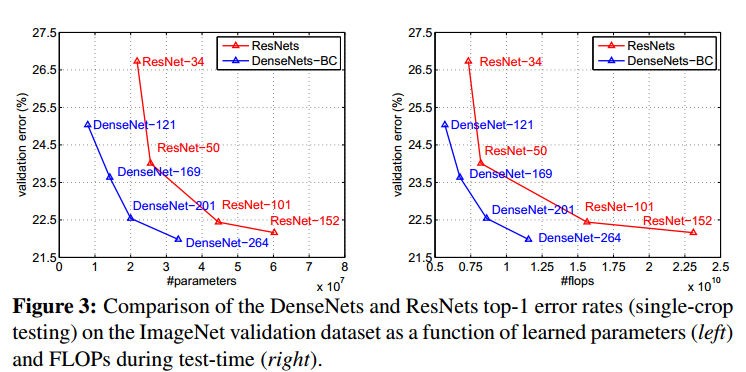
- We showed that DenseNets scale naturally to hundreds of layers, while exhibiting no optimization difficulties.
- Because of their compact internal representations and reduced feature redundancy, DenseNets may be good feature extractors for various computer vision tasks that build on convolutional features