Transfer Learning
(**) Transfusion: Understanding Transfer Learning for Medical Imaging. NeurIPS 2019, paper
Problem
- transfer learning is typically performed by taking a standard ImageNet architecture along with its pretrained weights, and then fine-tuning on the target task
- However, ImageNet classifcation and medical image diagnosis have considerable diferences.
- There is thus an open question of how much ImageNet feature reuse is helpful for medical images?
Difference between natural image classcification and medical image analysis
| ImageNet dataset | Medical image dataset | |
|---|---|---|
| Classes | 1000 | less than 10 in most tasks |
| image size | smaller | larger than natural image |
| Dataset size | a million | several thousands or a couple of hundred |
| data property | there is often a clear global subject of the image | variations in local textures to identify pathologies |
Contribution
- evaluate the performance of standard architectures for natural images such as ImageNet, as well as a family of non-standard but smaller and simpler models, on two large scale medical imaging tasks, for which transfer learning is currently the norm
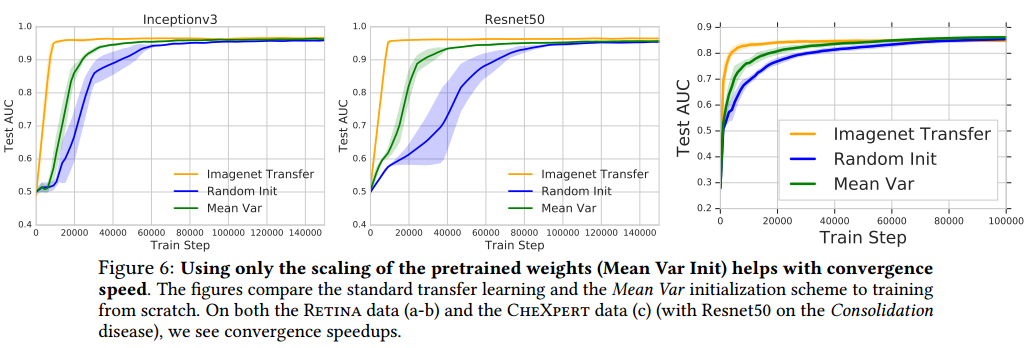
- We show there are also feature-independent benefits to pretraining — reusing only the scaling of the pre-trained weights but not the features can itself lead to large gains in convergence speed.
Results
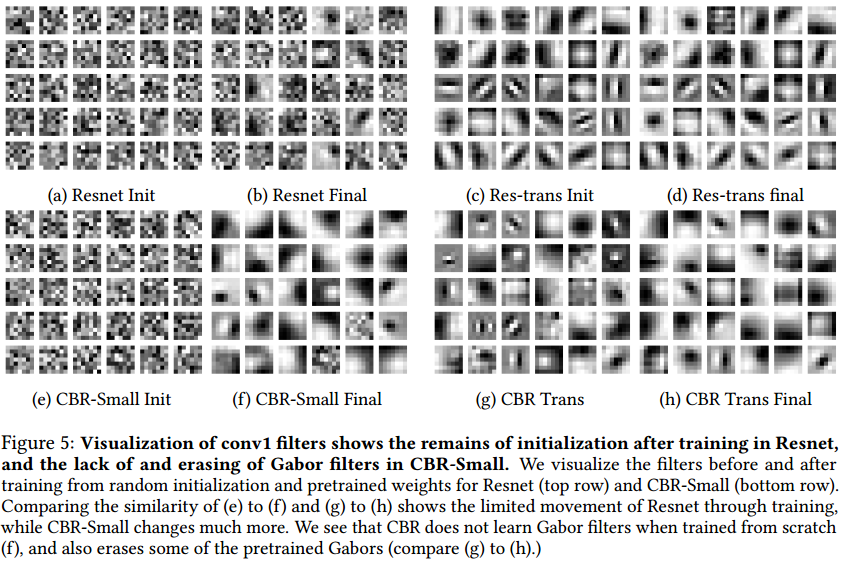
- in all of these cases, transfer does not signifcantly help performance
- smaller, simpler convolutional architectures perform comparably to standard ImageNet models
- ImageNet performance is not predictive of medical performance.